 Keepers
Smile science
Your Smile Ages, Too. Here Is What You Can Do About It.
We use sunscreen before the wrinkles. We exercise before we lose strength. Prevention, not repair, is how we look after the rest of our body. Yet most people never think about their teeth ageing, until the change is already done.
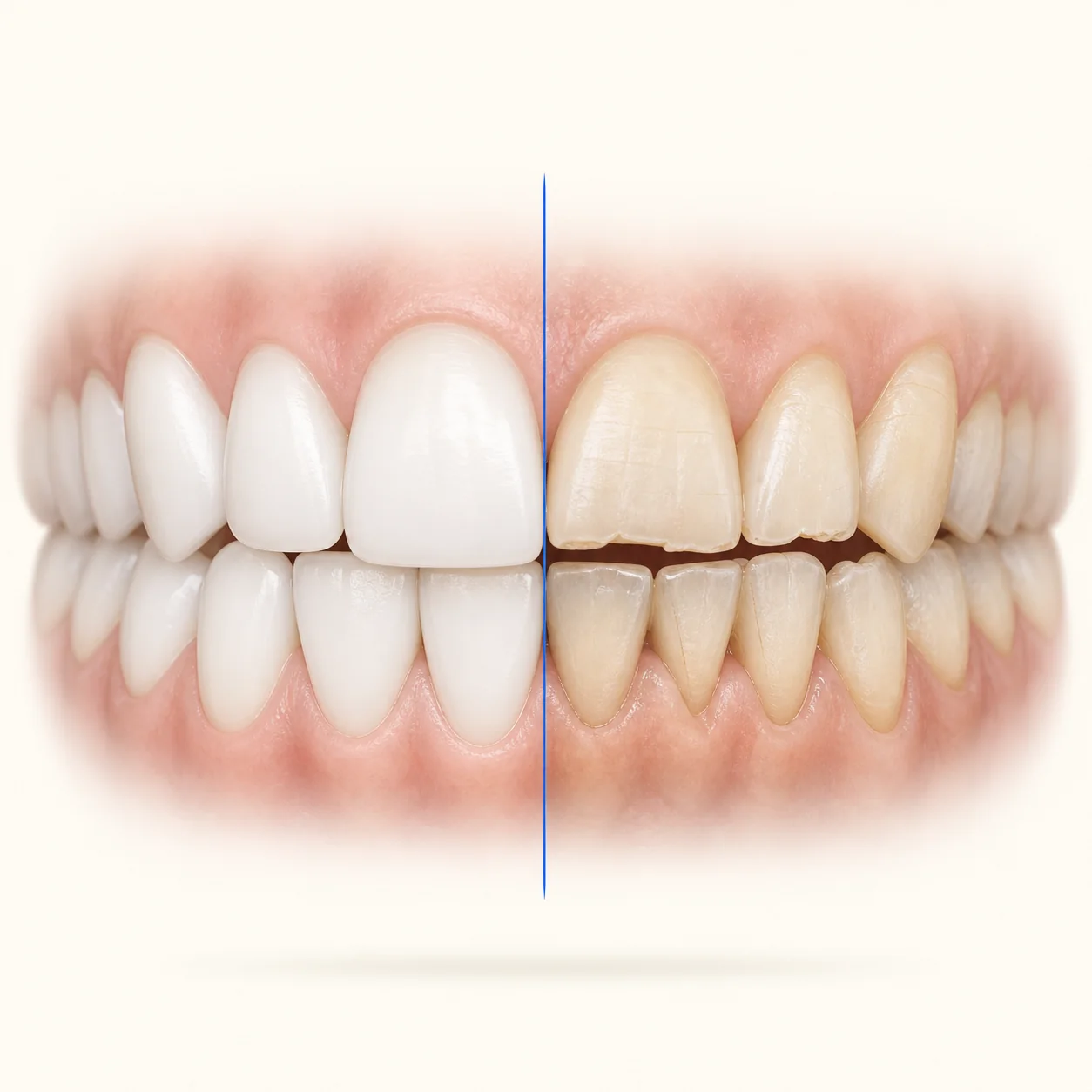
The same smile, younger and older: teeth gradually shift, crowd and wear over the years.
We protect our skin. What about our teeth?
Here is the part most people miss: your teeth age too. They gradually shift, crowd, and wear down over the years. It happens so slowly that you do not notice it, until one day your smile does not look or feel the way it used to.
The good news: unlike wrinkles, this is something you can act on early, with a simple nightly habit.
"Teeth and smiles age too. Teeth shift and wear down. Retainers can help limit that and help keep your teeth and smile looking younger for longer."
 Dr. Igor Gribalsky, orthodontist
1. Your teeth are not standing still
Teeth are not fixed in place. The bone and soft tissue around them keep remodelling throughout life, and the teeth move with them, even if you never had braces.[1][2] The clearest pattern: the lower front teeth crowd and become more irregular through adulthood, and those small changes accumulate right where they show, at the front of your smile.[3]
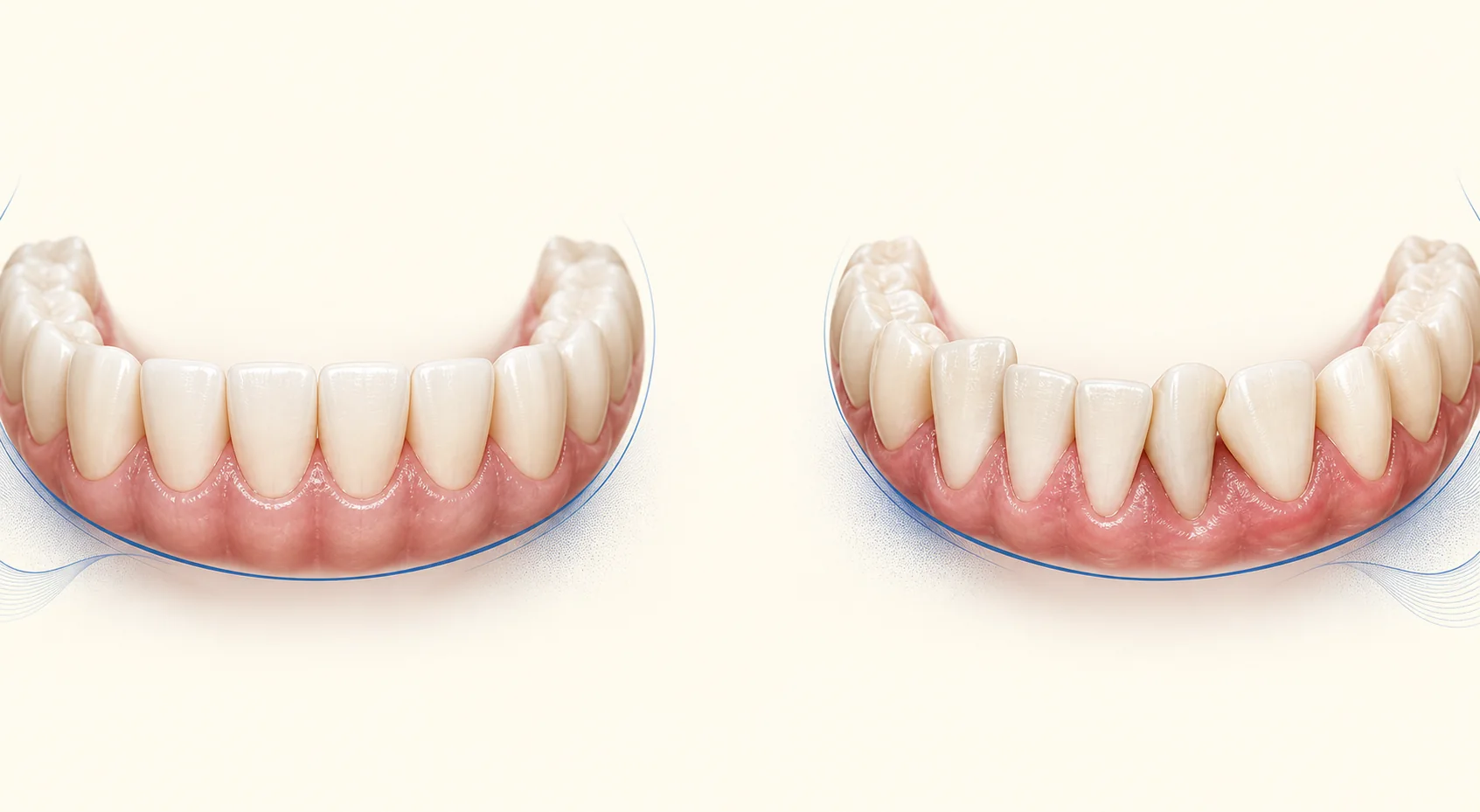
A straight lower arch (left), and the crowding that can develop over time (right).
"I often see adults come in for treatment in their 30s, telling me their teeth used to be straight, or that they have become noticeably crowded in recent years, more than before. Most often it is the lower teeth."
"The bone that surrounds the teeth keeps changing with age, just like our face, lips and skin change. Those changes in the bone around the teeth affect where the teeth sit."
Dr. Igor Gribalsky, orthodontist
2. Wear adds up, year after year
The second change is wear. Grinding, biting and everyday friction slowly reduce the height and shape of your teeth, and acidic food and drink add to it. Like shifting, it is cumulative, and it climbs steadily through adult life.[4][5]
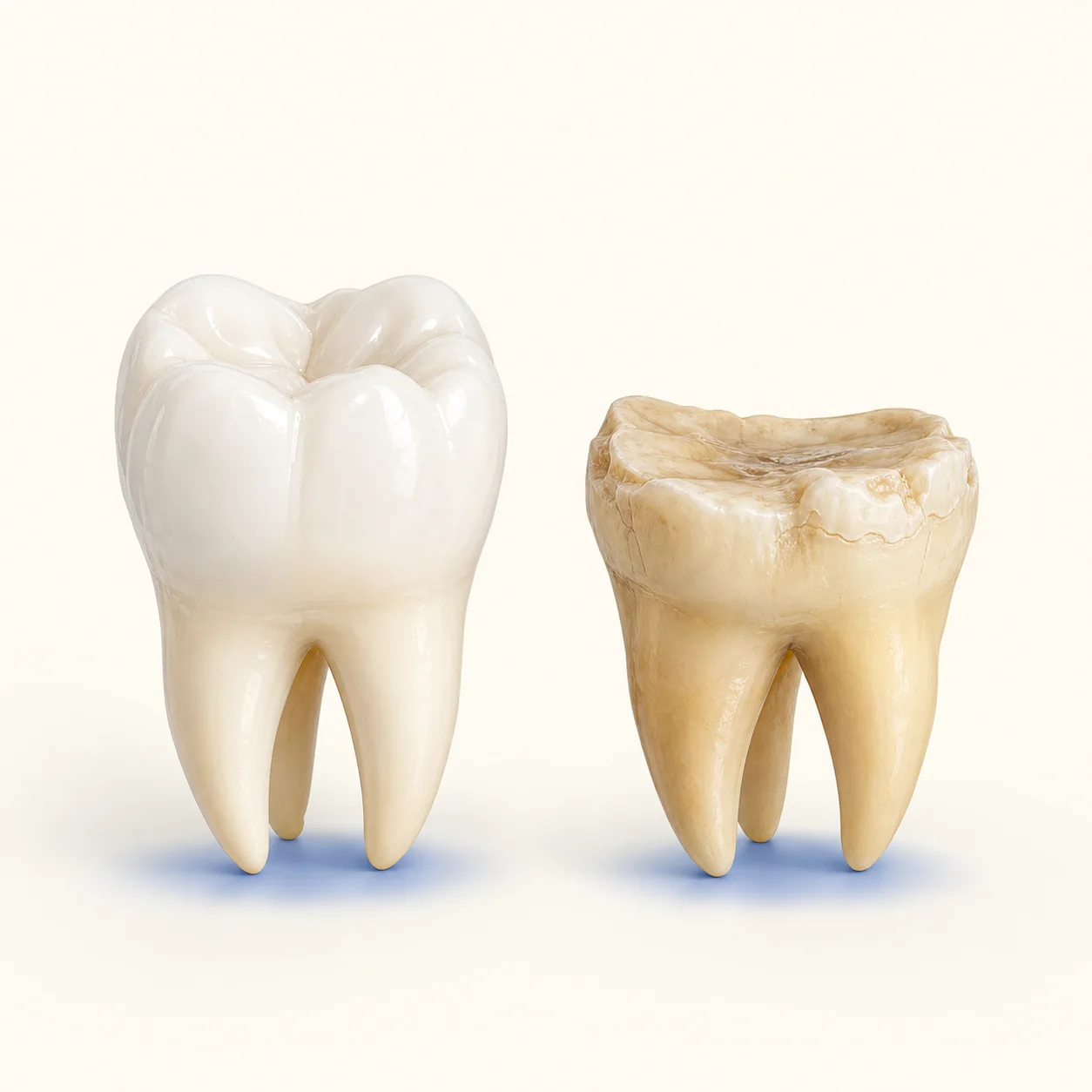
A healthy molar (left) and a worn molar with flattened cusps (right).
How common is it, really?
These charts use real survey data. Each bar shows, out of 100 adults in that stage of life, how many already have tooth wear. The pattern is simple: it starts young and keeps climbing as the years go by.
How many adults already have some tooth wear
Read it as: out of 100 people in each age group, how many show any tooth wear.
Adult Oral Health Survey 2023, England. Any tooth wear (BEWE) by age band.
How many adults have moderate tooth wear
It more than doubles, from about 1 in 10 in your late 20s to 1 in 4 by your late 40s.
Adult Oral Health Survey 2023, England. Moderate wear (BEWE), ages 25-34 vs 45-54.
"Tooth wear happens naturally for everyone, more for some, less for others. It can get worse during certain phases of life, like stressful periods, with day or night grinding from tense muscles or stress, or simply from a bite that promotes faster wear. A retainer worn in the evening and at night protects the teeth for many hours of the day, by preventing direct contact between the upper and lower teeth, and that slows the wear that would otherwise happen in those hours. It is especially valuable for people who tend to grind at night."
Dr. Igor Gribalsky, orthodontist
The cost of waiting
None of this reverses on its own. Once teeth have shifted or worn down, putting it right means treatment, time, and real expense, often far more than it would have cost to protect the smile in the first place. This is the simple, honest case for acting early: the same logic you already apply to your skin and your health. It is easier, cheaper and kinder to your future self to maintain than to repair.
Protect your smile with a custom retainer
Prevention, not correction
Two things are well established. First, teeth shift and wear with age. Second, retainers are an evidence-based way to help hold teeth in position; the top-tier Cochrane review confirms teeth tend to relapse after orthodontic treatment without retention.[6]
From there the preventive logic is straightforward. If a retainer helps hold teeth in place, it can be used proactively to help maintain alignment, for anyone who wants to look after their smile, not only people who once had braces. Worn at night, it also sits between the teeth and reduces the tooth-to-tooth contact of grinding, helping limit that kind of wear.[7][8]
"We know this shift is common, and we have a tool that is proven to help limit tooth movement. So why offer it only to people who had treatment? Everyone should be able to enjoy that extra protection."
Dr. Igor Gribalsky, orthodontist
The honest limits
We will not overpromise, because trust matters more than hype. Here is the line we hold:
| A retainer can | It can not |
|---|---|
| Help maintain tooth alignment over time | Stop teeth from ever moving, or reverse shifting that has happened |
| Act as a night barrier that helps limit grinding (attrition) wear | Stop all tooth wear, or protect against acid / reflux erosion |
| Be used preventively, not only after braces | Treat or cure grinding (bruxism), which it manages, not cures |
| Help you keep the smile you have, for longer | Reverse ageing, restore lost structure, or change your skin |
"A retainer cannot move teeth actively. It does not treat the underlying causes of grinding or jaw-joint problems. It acts as a shield between the teeth. It is not active treatment, it is preventive and prophylactic."
Dr. Igor Gribalsky, orthodontist
How Keepers fits in
Think of Keepers as a protective layer for your smile, and the simple system that keeps you using it. Your retainer is custom-made from a 3D scan in a certified EU lab, checked under orthodontist guidance, and delivered to you. We routinely recommend a hard, 1 mm-thin design worn on both jaws: comfortable enough for nightly use, it helps hold teeth in position and, by separating the teeth at night, helps limit grinding wear.
Reviewed by an orthodontist
The professional comments on this page are from Dr. Igor Gribalsky, who has clinical experience in orthodontic treatment and retention care. This guide is reviewed under his guidance.
Frequently asked questions
Sources
This page is based on peer-reviewed scientific reviews, studies, and a national oral-health survey. Key sources:
- Rajbhoj AA, et al. Dental changes in humans with untreated normal occlusion throughout lifetime: a systematic scoping review. Am J Orthod Dentofacial Orthop. 2021. doi:10.1016/j.ajodo.2021.02.014.
- Carter GA, McNamara JA. Longitudinal dental arch changes in adults. Am J Orthod Dentofacial Orthop. 1998. doi:10.1016/S0889-5406(98)70243-4.
- Buschang PH, Shulman JD. Incisor crowding in untreated persons 15 to 50 years of age, United States. Angle Orthod. 2003. PMID 14580016.
- Adult Oral Health Survey 2023, England (tooth wear prevalence by age, BEWE). Office for Health Improvement & Disparities / NatCen, 2025.
- Van't Spijker A, et al. Prevalence of tooth wear in adults. Int J Prosthodont. 2009. PMID 19260425.
- Martin C, et al. Retention procedures for stabilising tooth position after orthodontic treatment. Cochrane Database Syst Rev. 2023. doi:10.1002/14651858.CD002283.pub5.
- Clinical Quantitative Evaluation of Tooth Wear: A 4-year Longitudinal Study (occlusal splints / night guards in nocturnal bruxism). Oral Health Prev Dent. 2020. PMID 32895655.
- Prevention and Management of Tooth Wear: The Role of Dental Technology. Prim Dent J. 2016. PMID 28826461.
This is general educational information, not medical advice. Prevalence figures describe populations, not individuals. For diagnosis or treatment of grinding, tooth wear, or shifting teeth, consult a dentist or an appropriate specialist.
Get Started
Protect your smile with a custom Keepers retainer
Fill in the form and we'll contact you with the next steps and pricing.
Message Sent!
Thank you for reaching out. We'll be in touch within 1-2 business days with your next steps.